
Two climates, one mountain range apart
The Cape Winelands do not share one weather. West of the Du Toitskloof Mountains the winters are wet: Stellenbosch gets 878 millimetres a year, Paarl 770, most of it between May and August. East of the range, in the Breede Valley around Worcester and Robertson, only a fraction of that falls. Worcester gets about 273 millimetres of rain a year and averages 34 degrees in January, a good six degrees more than Stellenbosch.
Ceres is the odd one out. The town sits at 450 metres, winter nights are cold and the surrounding mountains often carry snow. Yet February still reaches 28 to 30 degrees.
Monthly figures exist for three towns. Those for Stellenbosch and Paarl are modelled values from climate-data.org, quoted by Wikipedia without a measurement period. Worcester's come from the Starlings Roost weather station at 270 metres, with 1991 to 2020 normals and rainfall records from 1880 to 2023.
| Averages | Jan | Feb | Mar | Apr | May | Jun | Jul | Aug | Sep | Oct | Nov | Dec | Year |
|---|---|---|---|---|---|---|---|---|---|---|---|---|---|
| Stellenbosch, day °C | 27.8 | 28.1 | 26.4 | 23.2 | 19.4 | 16.2 | 15.8 | 16.1 | 18.0 | 21.0 | 23.2 | 26.0 | 21.8 |
| Stellenbosch, night °C | 16.0 | 16.3 | 15.1 | 12.6 | 10.1 | 7.2 | 6.5 | 6.8 | 8.0 | 10.4 | 12.1 | 14.6 | 11.3 |
| Stellenbosch, rain mm | 33 | 35 | 36 | 60 | 95 | 141 | 127 | 107 | 86 | 68 | 53 | 37 | 878 |
| Paarl, day °C | 29.7 | 30.0 | 28.6 | 24.8 | 20.7 | 18.6 | 17.7 | 18.4 | 20.5 | 23.6 | 26.7 | 28.4 | 24.0 |
| Paarl, night °C | 15.8 | 16.1 | 14.6 | 11.8 | 9.1 | 7.0 | 6.3 | 7.0 | 8.6 | 10.9 | 13.2 | 14.7 | 11.3 |
| Paarl, rain mm | 16 | 21 | 26 | 73 | 117 | 132 | 116 | 109 | 61 | 49 | 29 | 21 | 770 |
| Worcester, day °C | 34.0 | 34.2 | 31.6 | 28.1 | 24.2 | 20.2 | 19.8 | 20.3 | 23.2 | 27.6 | 29.9 | 32.7 | 27.1 |
| Worcester, night °C | 17.1 | 17.3 | 15.3 | 12.6 | 9.5 | 6.9 | 5.8 | 6.6 | 8.5 | 11.4 | 13.5 | 16.1 | 11.7 |
| Worcester, rain mm | 6.9 | 9.0 | 12.6 | 23 | 32.3 | 46.5 | 39.2 | 37.4 | 24.8 | 20.5 | 12.2 | 8.6 | 273 |
For comparison, Cape Town airport: 29.0 degrees in January, 17.9 in July, 493 millimetres of rain a year (1991 to 2020 normals). So Paarl runs warmer than the airport in summer, and Stellenbosch, on the modelled figures, slightly cooler.
Robertson and Ceres: the sources disagree
There is no station table for Robertson. The site saexplorer.co.za gives about 255 millimetres of rain a year, peaking in August at 35 millimetres, with 29 degrees on February afternoons and 4.2 degrees on July nights. Weather Spark and climate-data.org arrive at 405 to 427 millimetres, with July the wettest month. The station in nearby Worcester points towards the lower figures. The only safe statement: Robertson is dry, well under 500 millimetres.
For Ceres the numbers drift even further apart. Wikipedia gives 1,088 millimetres a year, a February high of 29.9 degrees and 2.4 degrees on July nights, without citing a source. Saexplorer says 599 millimetres, 28.2 degrees in February and 3.8 on July nights, with most rain in June. For planning, take away that Ceres is wet and cold in winter; the exact amount is open.
Harvest: February to April
If you want to see the harvest, come between February and April. Depending on grape and site, some estates start in late January. The sources vary between February to March and late January to April, so ask the estate before you plan your trip around the harvest.

The harvest months are also high and late summer. Daytime highs in February reach 28 degrees in Stellenbosch, 30 in Paarl and 34 in Worcester. The rain takes a break.
Spring: September to November
Spring is flower season. At the Karoo Desert National Botanical Garden in Worcester most of the succulents bloom now, and the garden names spring as the best time to visit. Around Paarl and on the Bainskloof Pass the fynbos usually flowers from September to November. The days warm up, 18 degrees in Stellenbosch in September and 23 in November, and the rainfall drops clearly.
Spring also brings the south-easter. At the Cape it is called the Cape Doctor: strong, persistent, dry, and usually a fine-weather wind. It blows from September to March across much of the province. The Tulbagh basin is open to the south, and there it brings cooling in summer.
Summer and high season
From mid-December to mid-January South Africa has its summer holidays. That is high season, in the Winelands too, and from November to April wine tours should be booked one to two weeks ahead. If you travel in December or January, book early.
Cherry picking starts near Ceres at the end of November, at Klondyke Cherry Farm at 1,260 metres, and lasts until the end of December. Franschhoek holds its Cap Classique and Champagne Festival in early December. In the Breede Valley daytime highs climb to almost 33 degrees in December, so put tastings there in the morning.
Winter: rain, fireplaces, snow on the heights
June is the wettest month in Stellenbosch and Paarl, with 141 and 132 millimetres. Days reach 16 to 19 degrees, nights 6 to 7. The estates are quiet, fires are lit in many restaurants, and accommodation gets cheaper. A few restaurants close for a winter break, FABER at Avondale in Paarl for example from 22 June to 22 July 2026.
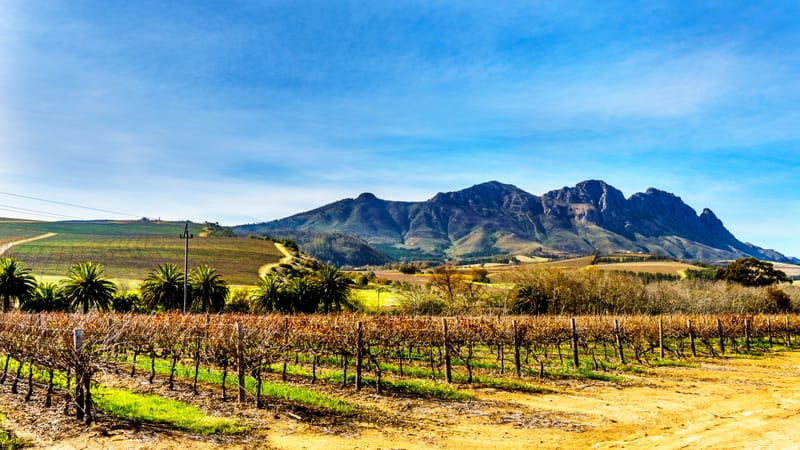
In winter the mountains around Ceres often carry snow, the valley floor rarely. The Koue Bokkeveld north of Ceres gets regular winter snow. The Matroosberg, at 2,247 metres the highest peak in the district, has a small ski area on its northern slope; the private nature reserve on Erfdeel farm is reached by four-wheel drive only.
Winter storms are the flip side. After the storms of 13 May 2026 the N1, the Huguenot Tunnel and several passes were closed for a time, and the Franschhoek Pass still is (as of September 2026).
Note In winter, check the province's closure notices before every mountain pass. Which passes are open and how to reach Franschhoek, Ceres and Tulbagh anyway is on getting there and car hire.
Frequently asked questions
When is harvest time in the Cape Winelands?
Harvest in the Cape Winelands runs roughly from February to April, and depending on grape and site some estates start in late January. Depending on the source it is February to March or late January to April.
How hot does Worcester get in summer?
The weather station near Worcester records average daytime highs of about 34 degrees in January and February, with only around 273 millimetres of rain a year. The Breede Valley around Worcester and Robertson is much hotter and drier than Stellenbosch and Paarl.
Does it snow in the Cape Winelands?
Snow often falls in winter on the mountains around Ceres, but rarely on the valley floor. The Matroosberg east of Ceres is the highest peak in the district at 2,247 metres and has a small ski area, and the Koue Bokkeveld to the north gets regular winter snow.
Is winter a good time to visit the Cape Winelands?
From June to August, Stellenbosch and Paarl see daytime highs of 16 to 19 degrees, with June the wettest month. The estates are quieter; a few restaurants close for a winter break, and winter storms can close mountain passes.
What is the south-easter in the Cape?
The south-easter, known as the Cape Doctor, blows from September to March across much of the Western Cape. It is strong, dry and usually comes with fine weather; in the Tulbagh basin it brings cooling in summer.