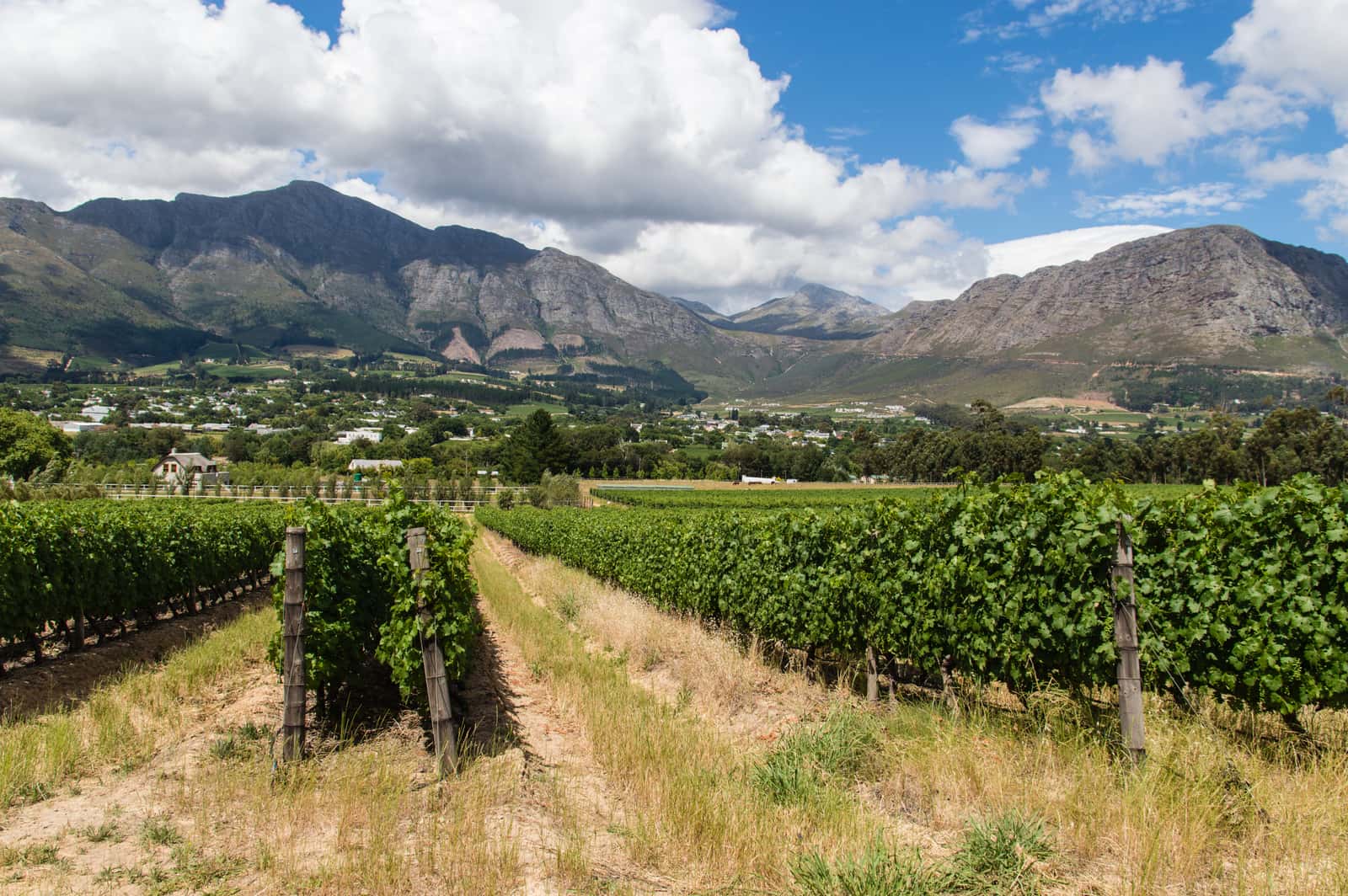
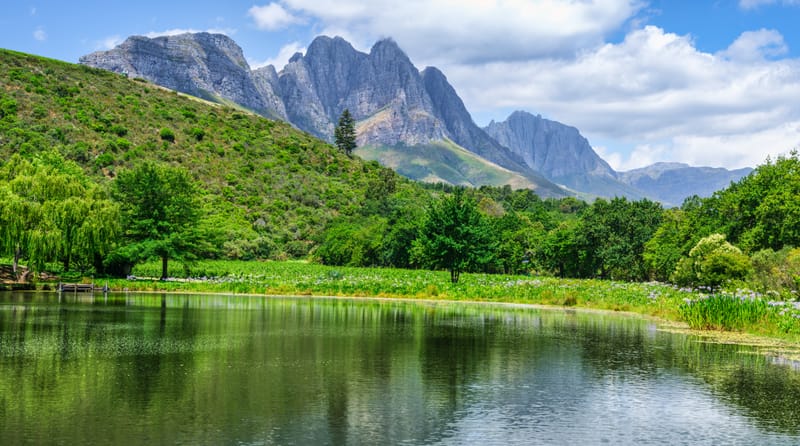
A July morning on the R60 beyond Worcester. Snow lies on the Matroosberg, the vines in the valley are pruned bare, and smoke rises from the farmhouse chimneys. An hour or so further east, in Montagu, water comes out of the rock at over 40 degrees.
The Cape Winelands start less than an hour east of Cape Town and stretch across five municipalities to the edge of the Klein Karoo. Most visitors see Stellenbosch and Franschhoek. That is not wrong, but it is the smaller part. Beyond the first mountain ranges lie Tulbagh, the Breede Valley, Robertson and Montagu, with fewer tour buses, cheaper tastings and roads where you can drive a long way without meeting anyone.
- Municipalities
- 5Stellenbosch, Drakenstein, Witzenberg, Breede Valley, Langeberg
- Population
- 862,7032022 census
- Area
- about 21,500 km²English Wikipedia gives 22,289
- Vineyards
- about 57,000 hafive SAWIS regions, roughly two thirds of South Africa, end of 2025
- From Cape Town
- 50 to 190 kmStellenbosch to Montagu
Five regions, and what sets them apart
Stellenbosch and Franschhoek are the classic valleys: oak-lined streets, Cape Dutch gables, estates with restaurants and gardens, and most of the region's beds. North of them, Paarl and Wellington sit on the Berg River below the granite domes of Paarl Mountain. Beyond Nuwekloof Pass and Michell's Pass come Tulbagh and Ceres, a basin full of heritage buildings and a plateau of orchards.
Through the Huguenot Tunnel you reach the Breede Valley around Worcester and Rawsonville, where more grapes grow than anywhere else in the district. Furthest east, Robertson, McGregor, Bonnievale and Montagu line Route 62: limestone soils, Chardonnay and Muscadel, hot springs and a tunnel through the rock.
The numbers behind it: according to the South African wine industry statistics (SAWIS), the regions of Paarl, Robertson, Breedekloof, Stellenbosch and Worcester held around 57,000 hectares of vines at the end of 2025, two thirds of the national total. The statistical regions do not match the district exactly; Stellenbosch, for example, includes Somerset West.
What to know before you set off
Franschhoek Pass (R45) has been closed since the storms of 13 May 2026, and Bain's Kloof Pass has only been partly open, with stop-and-go control, since 10 July 2026. Both change routes you will find in older guidebooks. The current situation is on the routes and passes page, as of September 2026.
The second thing is the drink-driving limit. South Africa allows 0.05 grams of alcohol per 100 millilitres of blood, 0.02 for professional drivers, and the roads between estates are checked. If you plan three tastings in a day, plan a driver, a tour or the Wine Tram in Franschhoek. More under getting there and car hire.
Anything on this site that can change carries a date. Where sources disagree we give both figures and name the source instead of inventing an average. Prices for places to stay and wines come from partner feeds and apply to the day shown.
Our tipStart with the classic valleys and then head east. Visit Stellenbosch at the weekend and Robertson on a weekday and both will be quieter; the Breede Valley is on the way to the Garden Route anyway.
Questions about the Cape Winelands
Which towns are part of the Cape Winelands?
The Cape Winelands district includes Stellenbosch, Franschhoek, Paarl, Wellington, Tulbagh, Ceres, Worcester, Rawsonville, Robertson, McGregor, Bonnievale and Montagu, among others. Somerset West and Constantia belong to the City of Cape Town, and Riebeek-Kasteel to the Swartland.
Where are the Cape Winelands?
The Cape Winelands lie in the Western Cape, east and north-east of Cape Town. Stellenbosch is about 50 kilometres from Cape Town, Montagu on the eastern edge about 190 kilometres.
Can you visit the Cape Winelands without a car?
Without a car you can see the Cape Winelands on guided tours from Cape Town, on the Wine Tram in Franschhoek and with ride services inside the towns. For Tulbagh, Robertson or Montagu a hire car is practically essential, and whoever tastes should not drive anyway.
How big is the Cape Winelands district?
The Cape Winelands district covers five municipalities with a combined 862,703 residents in the 2022 census. Sources give its area as 21,473 or 22,289 square kilometres.